


Brand Strategy.
How brand strategists actually think, and why the work is in what you choose not to do.
Read the full transcript
Years ago, I was working at a global agency in New York as a design and strategy lead. Our client was one of the largest commercial real estate services firms in the world. Fortune 500. Nearly a hundred thousand employees. Operations in more than eighty countries. Five business units. Capital markets, workplace services, proptech venture, investment management, advisory. Dozens of CMOs across the business, each running a different geography or business line. And a list of industries the company served that ran to about twenty entries. Data centers. Healthcare. Hospitality. Financial services. Government. Law firms. Retail. On and on.
Our assignment was to build their global brand messaging house. The document that defines, for the whole company, what the brand stands for and what every business unit has to align with.
I remember the moment I realized what was actually happening on that project.
The senior strategist had just added another audience. Another vertical. Another activation. There was going to be a coworking space launch. An industry-specific sub-campaign. A sustainability showcase. A technology demonstration. Every week, more. Never less.
I looked at the latest draft and I realized. Across six months of work, in dozens of meetings, with a room full of smart people, nobody had asked the one question that actually separates strategy from activity.
"What did we decide not to do?"
I could not think of an answer. Not one vertical we had cut. Not one audience we had said was not for us. Not one claim we had abandoned because another one was stronger. The document was going to cover every business unit, every region, every industry, every CMO's priorities.
The brand guideline we eventually shipped was two hundred pages. Two hundred pages. The longest single brand document I have ever been part of. Every page was well-designed, internally coherent, professionally researched. And none of it closed a door.
That project is what I want you to hold in your head while I walk through this episode. Because what that team had built was not a strategy. It was a menu of activities wearing a strategy's clothes. And until you understand the difference, strategy from activity, nothing you produce downstream will cohere.
This is episode two. Today I want to talk about how brand strategists actually think. Not about frameworks, not about positioning exercises, not about any specific deliverable. About the underlying mental habit that separates strategic work from activity.
I'm John Luke. Welcome to Position to Win. There are two types of brands. The ones that accept their position in the market, and the ones that challenge it. This show is for the challengers. And for the founders and CMOs who are the ones responsible for making that happen.
The three brand pillars
Before I get into the principles, I want to pull one specific artifact out of that project and sit with it, because it makes the diagnosis concrete.
The three brand pillars we had landed on, after months of workshops, research, debate, and executive sign-off, were these. Technology-enabled insight. Sustainability as a return on investment. The future of workplaces.
Read those three again. Now ask yourself the question that separates a theme from a position. Which of those could a competitor not also claim tomorrow?
Every commercial real estate firm in the world could put all three on their own slide with a straight face. Not one of them closes a door. Not one of them excludes a competitor. Not one of them excludes a customer. They are themes, not positions. They describe the category we happened to work in. They do not describe us within that category.
That is the tell. When your brand pillars could sit unchanged on your competitor's slide, you do not have a position. You have a summary of the space you operate in. And a summary is not something the market remembers. It is something the market skims.
Add versus choose
Here is the distinction that should run through your head every time you are in a planning meeting.
Most marketers are trained to add. Add channels. Add messages. Add content. Add experiments. Add "and also this" to every slide.
Strategists are trained to choose.
A strategist's job isn't to say what could work. It's to decide what will be true. And what won't.
That last line is the whole job. A good strategy is not a prediction about the future. It is a commitment about the future. A set of statements the team has agreed to be held to. "We are this, not that. We serve these people, not those. We win this way, not that way." Everything downstream flows from those choices.
Companies struggle with this because choosing is uncomfortable. Every choice closes a door. Every "we are this" implies a "we are not that," and the "not that" is what keeps founders awake at night. So most companies quietly avoid the discomfort by refusing to close doors. They produce a "strategy" that is really a list. A menu. A bet on everything.
If your strategy reads like a menu, it is not strategy. It is activity.
A real strategy makes you uncomfortable, because it closes doors.
- We're for this buyer, not that one.
- We win in this moment, not every moment.
- We lead with this claim, not five claims.
- We're priced like this, not like them.
- We sound like this, not like "everyone."
That is the work. A page with five sentences like those is worth more than a hundred-slide deck without them. Because a hundred-slide deck that refuses to choose is just aspiration expressed at scale.
I want to say this clearly, because it is the load-bearing idea of the episode. The measure of a strategy is not how much ground it covers. It is how many other things the team has explicitly agreed not to do. When you read a company's strategy document, you can tell whether they are actually doing strategy by counting the "nots." If there are no "nots," they have a list, not a strategy.
Why choosing matters commercially
Here is the commercial reason choosing matters. People don't remember brands that try to cover everything. They remember the brand that took a clear stance.
Think about how the market actually stores you in memory. You are not remembered as a feature list. You are remembered as a single phrase. "The one for designers." "The one for developers." "The one where you can get anything by tomorrow." "The one that stands for less stuff." If you have not chosen a phrase, the market will not remember you. It will remember whoever chose more clearly, and you will be one of the also-rans.
So a strategist keeps asking.
- What's the single most important thing we want to be known for?
- What's the one problem we want to own?
- What's the one buyer we want to win first?
If you can't answer those, you don't have focus yet. You have options.
And options are not a position. Options are what you have before you have done the strategic work. The whole point of strategy is to convert options into commitments.
Figma
Let me now put a positive example next to the one I opened with. A company that made the uncomfortable choice and won because of it.
In twenty twelve, Dylan Field and Evan Wallace started building Figma. The design tools market at the time was dominated by Adobe. Photoshop, Illustrator, InDesign, XD. A full suite of creative tools used by every kind of creative professional, from photographers to graphic designers to product designers. Adobe's strategy was to cover everything creative. It was a suite play.
Figma could have tried to compete as a better suite. They could have said "we are a more modern design tool for everyone who makes creative work." That would have been the menu approach. Cover everything. Try to pick off users in every category.
Instead, Figma made a choice that was uncomfortable at the time. They decided to be for one specific kind of user. Product designers working on teams inside software companies. Not photographers. Not illustrators. Not graphic designers working on print. Not solo freelancers. Product designers in software companies.
That choice closed doors. It meant Figma was not competing for Photoshop users or Illustrator users or print designers. For several years, that looked like a handicap. Adobe had twenty times the total addressable market.
But the choice also opened a specific lane so wide that Figma could become the obvious answer inside it. They built for the one workflow that matters most to product design teams. Real-time collaboration in the browser. That feature, inside that specific workflow, inside that specific audience, was enough to turn Figma into the default design tool for an entire category of software company.
Adobe tried to acquire Figma in twenty twenty-two for twenty billion dollars. The deal ultimately did not close. Regulators blocked it. But the valuation is what I want you to remember. Twenty billion dollars for a company that had deliberately narrowed itself to one audience and walked away from every other slice of Adobe's market. Figma was not bought because it had become a smaller version of Adobe. It was bought because it had become the undisputed owner of one specific audience that Adobe could no longer win back. The only way Adobe could get those users was to acquire the company that had locked them in.
That is what choosing looks like. It is not about being small. It is about being the obvious answer to a specific question that a specific set of customers is asking. Compare it to the real estate project I opened with. Same kind of ambition, same kind of talent in the room, same amount of work. Different habit. One of those companies said "product designers in software companies." The other said "everyone, everywhere, across twenty industries." One of them became a twenty-billion-dollar brand. The other shipped a two-hundred-page guideline that nobody could summarize.
Tradeoffs are proof of choosing
Now, here is the part most founders do not want to hear. Every strong position has a downside. That's not a flaw. That's proof you're choosing.
Tradeoffs show up everywhere.
- If you go premium, you lose price shoppers.
- If you go niche, you lose "everyone" deals.
- If you go simple, you lose edge-case features.
- If you go bold, you lose safe approval.
Marketers often try to write strategy that avoids tradeoffs. They want the premium positioning and the volume customer. They want the niche audience and the mass appeal. They want the simple product and the edge cases handled. It cannot be done. Strategy that avoids tradeoffs is strategy that has not actually been written.
Strategists do the opposite. They name the tradeoffs. They accept them. They use them.
The acceptance is the part that founders struggle with most. "Yes, we are going premium, which means we will lose this segment. We are okay with that. In fact, that is the whole point." That sentence, said out loud with confidence, is worth more than any piece of brand work that tries to hedge.
If nobody disagrees with your positioning, it's probably too vague.
A good positioning should provoke disagreement somewhere. A competitor should feel attacked. A segment of customers should feel excluded. An internal team member should think "I'm not sure we should be this narrow." If nobody in your orbit flinches, the position is too comfortable, which usually means too generic.
Figma's positioning provoked disagreement. "We are only for product designers in software companies." That choice offended every other kind of designer who thought the tool could serve them too. It offended the salespeople who wanted to sell into creative agencies. It offended the investors who wanted a bigger TAM. And that offense was a signal that Figma had actually chosen something. The discomfort was the evidence that the strategy had teeth.
Think about the real estate company I opened with. If we had tried to narrow the positioning down to a single audience, "this brand is for institutional investors, and we will not lead with occupier or tenant messaging," every stakeholder in the building would have pushed back. The occupier business unit would have said "but we bring in half the revenue." The industry verticals would have said "but we serve all twenty." The regional CMOs would have said "but my market is different." Every narrowing provokes a defense from whoever feels excluded. That is the test. If nobody is flinching, the choice has not actually been made.
Focus is sequencing, not minimalism
Here is where a lot of founders mishear the advice. They think focus means minimalism. Focus is not minimalism. It's sequencing.
A minimalist company is a small company by design. A focused company is a company that knows what to do first, and what to do second, and what to do in year three. It still has ambition. It still wants to grow. But it refuses to do everything at once.
A strategist asks three questions when deciding what to focus on right now.
- What matters most right now for this stage?
- What needs to be true for growth to happen?
- What is the smallest set of messages that can carry the whole story?
Focus keeps the brand from becoming a "we do everything" blob. It keeps the team aligned. It keeps the work shippable.
The "we do everything" blob is what happens to most mid-stage companies. They added a product line three years ago because a customer asked. They added a vertical two years ago because a partnership came up. They added a price tier last year because sales wanted one. Each addition made sense on its own. Taken together, they produced a company that cannot be described in one sentence.
Focus is how you get out of the blob. It is how you say "these three things are the priority. The others may be true, but they are not the message. They are downstream." Without that kind of focus, every marketing dollar gets diluted across too many claims to compound anywhere.
The three-question filter
When you're stuck, when you are in a planning meeting and cannot decide between options, run every decision through three questions.
Question one. Does this make us easier to choose?
If it adds confusion, it's not helping. Every additional thing you add to your positioning, your messaging, your product line. Every addition has to pull its weight by making the customer's decision easier. Not harder. If the thing you are considering makes the buyer hesitate, it is working against you. Cut it.
Question two. Does this create a stronger point of view?
If it could describe any competitor, it's weak. The language of your strategy has to be something your competitors genuinely cannot claim. "We are customer-obsessed" is not a point of view. Anyone can say that. "We refuse to add a feature unless it works for ninety percent of our users" is a point of view, and your competitor who adds everything for everyone literally cannot say that.
Question three. Does this match the stage we're in?
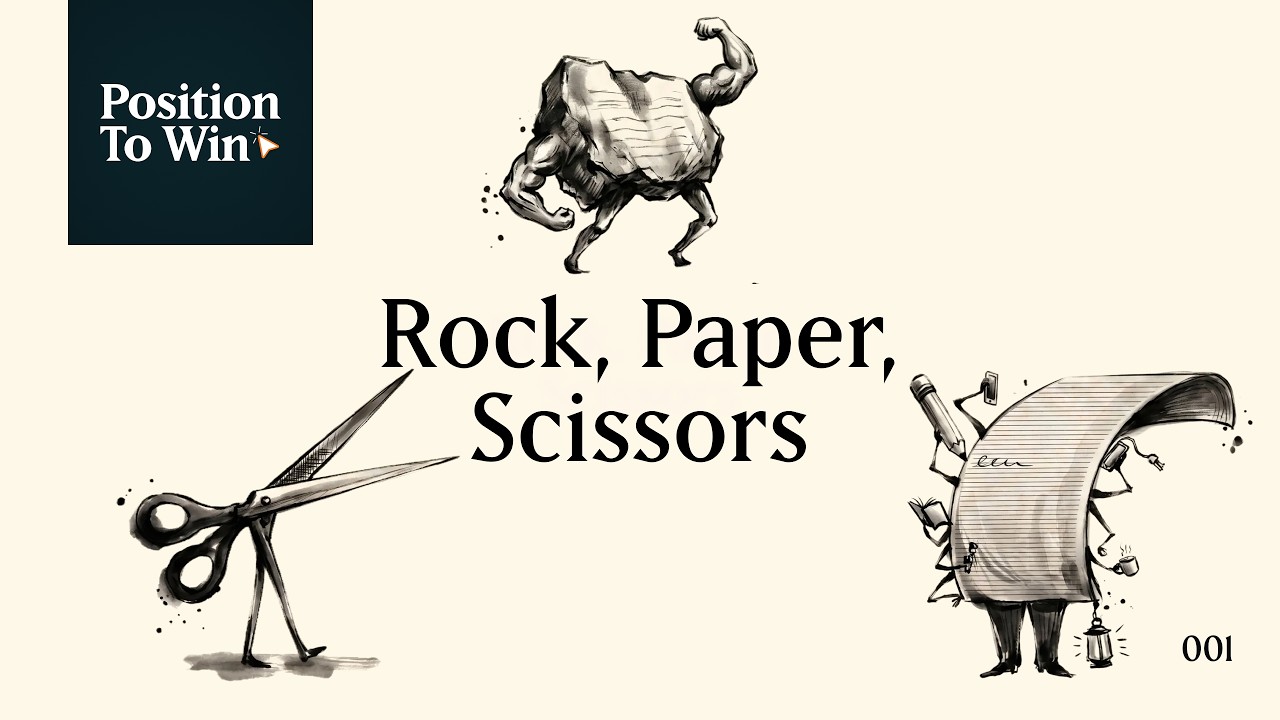
What works for Rock brands can break Scissors brands.
If you are a fifteen-million-dollar company and you are copying the strategy of a hundred-million-dollar company, you are going to fail. You do not have the distribution, the capital, the team, or the credibility to execute that strategy. Your strategy has to match your stage. We talked about this in episode one. Competing down-cycle, not up-cycle.
Three questions. Easier to choose. Stronger POV. Right for the stage. If a decision does not pass all three, the decision is not strategic. It is reactive.
The mid-stage shift
For the kind of company I usually work with, five to a hundred million in revenue, real traction, getting ready to scale, the hardest single shift in how the leadership team operates is the shift from the additive mindset to the choice-making mindset.
When a company is small, survival requires adding. You take any customer. You say yes to any channel. You ship any feature. You do not have the luxury of choosing. Choosing would kill you, because you cannot afford to turn anything down.
But the habits that keep a company alive at one million in revenue start to kill it at twenty million. Saying yes to every customer means the product roadmap is fragmented. Selling into every vertical means the sales team cannot specialize. Offering every tier means the pricing page confuses. The things that made you nimble become the things that make you incoherent.
The transition from "add everything" to "choose deliberately" is the transition from operator to strategist. It is the single highest-leverage mental shift a founder can make at the five-to-ten-million-dollar stage. And it will be uncomfortable, because it requires you to do things that felt dangerous when you were smaller.
Your new reflex
If you want to become a strategist, your new reflex is this.
Stop asking "What should we do?"
Start asking "What are we choosing?"
That shift is the whole game.
Every meeting you walk into, every document you review, every plan you are asked to approve. Hold that question in your head. What are we choosing. What are we not doing. What door is this decision closing. What trade are we accepting.
If the answer is "nothing, we are doing everything," then the meeting is not strategic. It is activity planning. There is nothing wrong with activity planning. It is how work gets done. But do not confuse it with strategy, and do not let the team think it has done strategic work when it has just produced a list.
The companies I have watched compound the hardest are the ones that got addicted to the discomfort of choosing. They got used to saying no. They got used to making one claim and letting the rest go. They got used to tradeoffs being the cost of being remembered.
That discomfort is the price. Strategy is a tax you pay in certainty about what you are not. And once you pay it, everything downstream, positioning, naming, identity, voice, story, marketing, sales, gets easier, because it has something to point to.
The takeaway
So here is your takeaway. A strategy is a set of decisions, not a set of activities. If it does not close doors, it is not a strategy. If it does not provoke some disagreement somewhere, it is too vague. If you cannot answer "what are we not doing," you have not yet done the work.
The three-question filter stays with you forever. Does this make us easier to choose. Does this create a stronger point of view. Does this match our stage. Hold the filter up to every decision you make for the next year, and you will start to see the difference between strategic work and activity.
Next episode, we put the first big choice on the table. Who are you for. We are going to go deep on ICP. Ideal Customer Profile. The single most downstream-affecting decision in all of brand strategy, and the one most companies avoid by calling their target market their ICP. I will give you the process I run with clients, the four attributes that matter, and the "not our ICP" list that is harder to write than the "our ICP" one.
Thanks for listening. Talk soon.
More episodes

When to Rebrand
Brand Repositioning

Brand Diagnosis
Brand Recall

Brand Persuasion
Brand Archetypes

Brand Voice

Brand Identity

Brand Name

Brand Architecture

Brand ICP
Rock, Paper, Scissors
New episodes in your inbox.
One email when a new episode drops. No drip, no upsell.